What Lloyd's Certification Actually Means for Yacht Owners
Lloyd's Register certification isn't just a badge — it affects your insurance premiums, class survey outcomes, and the yard you can work with. Here's what every yacht owner, captain, and management company needs to know.
What Lloyd's Certification Actually Means for Yacht Owners
Lloyd's Register certification comes up in almost every conversation about yacht fabrication, class compliance, and insurance underwriters. But what does it actually mean — and does your project need it?
This guide breaks it down plainly. No marketing language. Just the facts that affect your yacht, your refit budget, and your relationship with your flag state.
What Is Lloyd's Register?
Lloyd's Register (LR) is one of the world's oldest classification societies, founded in 1760. Unlike a flag state authority — which grants registry and basic safety compliance — a classification society independently verifies that a vessel is designed, built, and maintained to technical standards that reduce risk.
For yachts, the key classification societies are: Lloyd's Register (LR), American Bureau of Shipping (ABS), DNV (Det Norske Veritas), Bureau Veritas (BV), and RINA.
LR holds roughly 25–30% of the world fleet under class. It's particularly prevalent on large commercial vessels, but also common on superyachts above 500GT, especially those flagged in the UK, Cayman Islands, or Isle of Man.
What Does Classification Actually Cover?
A vessel under Lloyd's class is subject to rules covering five main areas:
- Hull Structure — shell plating, frames, watertight bulkheads, stability calculations
- Machinery & Systems — propulsion, steering, thrusters, generators
- Electrical Installations — power generation, distribution, emergency systems
- Fire Protection — detection, suppression, structural fire protection
- Pollution Prevention — bilge, sewage, garbage, air emissions
Any fabrication that touches these areas — new steel structure, alloy topsides, machinery foundations, exhaust systems, custom deck hardware — may require LR plan approval, material certification, and survey sign-off.
Why It Matters for Insurance
This is where it gets expensive if you get it wrong.
Most marine insurance underwriters require valid class certification as a condition of coverage. If your yacht's class lapses — even briefly — many policies contain a clause that voids or limits coverage until class is restored.
Underwriters also scrutinize the yard performing the work. A fabricator with LR type approval or recognized workshop certification carries less risk in the insurer's model. Uncertified yards doing structural work can trigger higher deductibles or exclusions.
Bottom line: class compliance isn't just about regulations — it's a direct lever on your insurance cost and your ability to make a claim.
The Survey Cycle — What to Expect
Under LR rules, yachts follow a survey cycle:
- Annual Survey — within 3 months before or after each anniversary of class renewal
- Intermediate Survey — at the halfway point of the class period, replaces one annual
- Class Renewal Survey — every 5 years for most yachts; comprehensive inspection of all class systems
If you're planning a significant refit — say, a new carbon hardtop, bulwark rebuild, or exhaust system — coordinate with your LR surveyor early. Fabricated items that require LR plan approval need to be submitted before construction starts, not after.
What It Means for Fabrication Quality
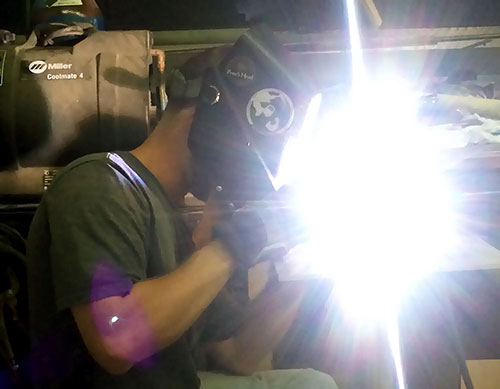
LR class doesn't just check the final product — it audits the process. Certified fabricators work to approved quality management systems, use traceable materials (mill certificates, welder qualifications, NDT testing), and maintain inspection records.
For yacht owners, this means:
- Traceability — every plate, tube, and weld has paperwork. You know what was used and why.
- Welder Qualification — LR requires welders to hold specific qualifications for the process and material. 6GR is standard for critical piping and hull structure.
- NDT Requirements — radiographic testing, ultrasonic testing, or magnetic particle inspection for structural welds, depending on stress category.
- Material Certifications — steel, aluminum, and stainless must come with mill test certificates showing chemical and mechanical properties.
A fabricator without these systems in place can produce a cosmetically perfect result that's structurally questionable. Class rules exist to prevent exactly that.
How to Verify a Fabricator's LR Certification
Ask for these before signing a contract:
LR Type Approval or Workshop Recognition — LR publishes lists of recognized firms. Check the current LR ShipRight register at lr.org. If the yard doesn't appear, ask why.
ISO 9001 or ISO 3834 Certification — Not LR-specific, but demonstrates a functioning quality management system. ISO 3834 is the specific standard for fusion welding of metallic materials.
Welder Qualification Records — Request copies of current WPQRs (Welding Procedure Qualification Records) for each process and material grade they'll use on your project.
NDE Technician Certifications — ASNT or PCN certifications for any non-destructive examination they'll perform. Radiographic and ultrasonic operators must hold specific Level II or III certifications.
Reference Projects Under LR Survey — Ask for LOIs (Letters of Intent) or survey reports from previous yacht projects. A yard that hasn't worked under LR survey before will need more oversight from your surveyor.
Lloyd's Listed vs. Lloyd's Type Approved — Know the Difference
This trips up a lot of owners and captains.
Lloyd's Type Approval is the stronger designation. It means a product or workshop has been audited by LR against specific rules and found to meet them. Type-approved firms appear in LR's official register.
A fabricator who is simply "listed" may have submitted documentation at some point but not undergone the same audit process. Listing is not a substitute for type approval when class compliance is on the line.
If your insurer asks for a class-certified yard, a listing is not the same as type approval. Get clarity in writing before the contract is signed.
When LR Certification Is Required — and When It Isn't
Not every fabrication project on a classed yacht requires LR involvement. The line is drawn by the scope of work and its effect on class notation:
- Structural steel or aluminum fabrication — almost always requires plan approval and survey sign-off
- Exhaust system modifications — require approval if they affect machinery or pollution prevention equipment
- Deck hardware and railings — structural items load-bearing for crew safety need approval; pure cosmetic items typically don't
- Interior outfitting modifications — usually outside class scope unless they affect fire protection, stability, or watertight integrity
Your LR surveyor can tell you exactly what approval is required before the yard starts work. The cost of a pre-survey meeting is negligible compared to re-doing structural fabrication that wasn't approved.
What DolFab Delivers Under LR Scope
We work with yacht surveyors and management companies to deliver fabrication under LR survey requirements. Every project includes:
- Approved drawings and WPS (Welding Procedure Specifications)
- Full material traceability with mill certificates
- Welder and WPS qualification records
- NDT inspection reports as required by survey scope
- Class surveyor coordination throughout fabrication
If you're managing a refit and need a fabrication partner who can operate inside LR class requirements, reach out before the refit specification is finalized. We'd rather review the scope early than be handed a drawing that needs to be redesigned.
Key Takeaways
- LR classification is a risk management system — it protects your yacht, your insurance coverage, and your crew.
- Class lapses can void or limit insurance coverage. Keep your survey dates current.
- LR-certified fabrication requires traceable materials, qualified welders, and documented processes — not just a good-looking result.
- "Lloyd's listed" is not the same as "Lloyd's type approved." Verify the designation before contracting.
- Coordinate with your LR surveyor before fabrication starts, not after.