Marine vs. Commercial Grade Welding — What’s Actually Different
Marine grade is an unregulated marketing term. Here’s what actually separates professional marine fabrication from a bill of goods — certifications, alloy specs, and the questions that separate qualified fabricators from the rest.
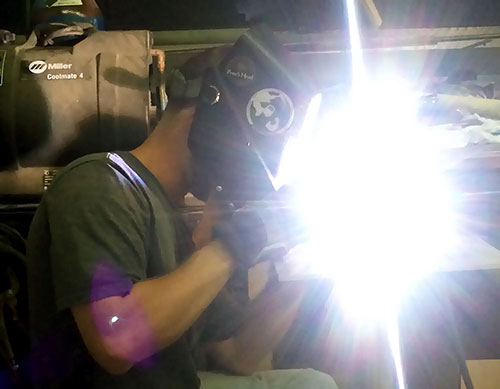
Marine vs. Commercial Grade Welding — What’s Actually Different
By DolFab | June 2026
The Problem With "Marine Grade"
That phrase is meaningless.
Anyone can use it. No regulation stops a fabricator from calling cheap carbon steel "marine grade" and charging a premium. No government body enforces it. No standard defines it.
What actually protects your vessel — and your crew — is documentation. Certifications. Traceable, verifiable proof that the welds holding critical structure together were made by qualified people using qualified procedures in a controlled environment.
This guide cuts through the marketing noise so you can ask the right questions and know when someone’s giving you real marine fabrication versus a bill of goods.
Part 1: Stainless vs. Carbon Steel — Know Your Alloys
Commercial Carbon Steel (A36, A572, A588)
Used in buildings, bridges, and commercial construction. High strength, low cost, no inherent corrosion resistance. Relies entirely on coatings (epoxy, polyurethane) and cathodic protection (zinc anodes) to survive in marine environments.
Bottom line: Fine for hull plating if coatings and anodes are maintained. Catastrophic if they’re not.
304 Stainless — Not For Saltwater
18% chromium, 8% nickel, zero molybdenum. The most common "stainless" grade. Looks great at the fabricator’s shop. In a marine environment, pitting initiates within 6–18 months. Pitting rate accelerates in splash zones and around fittings where seawater concentrates.
Avoid for any component exposed to saltwater or salt air.
316L Stainless — The Marine Baseline
16–18% chromium, 10–14% nickel, 2–3% molybdenum. The molybdenum is the differentiator — it resists chloride-induced pitting and crevice corrosion. The "L" means low carbon (max 0.03% vs 0.08%), which reduces sensitization risk during welding (chromium carbide precipitation at grain boundaries destroys corrosion resistance).
For underwater hardware, rudder posts, prop shaft assemblies, and saltwater piping — use 316L as your minimum.
Duplex 2205 — When 316L Isn’t Enough
50/50 austenite/ferrite microstructure. 22% chromium, 5% nickel, 3% molybdenum. Twice the yield strength of 316L (450 MPa vs 220 MPa), meaning you can use thinner sections and save weight — significant on any vessel.
PREN (Pitting Resistance Equivalent Number) of ~35 vs ~24 for 316L. Handles warmer seawater, stronger tidal currents, and more aggressive environments.
Required for: Propeller shafts, offshore platform components, high-stress structural marine hardware, underwater piping in aggressive environments.
Critical welding constraint: Interpass temperature must stay below 150°C (300°F). Heat input must be 0.5–2.5 kJ/mm. Exceed these and the ferrite/austenite balance degrades — the duplex microstructure collapses and you lose the corrosion resistance you paid for.
Super Duplex 2507 and Super Austenitic AL-6XN
Reserved for the most demanding environments: seawater-cooled heat exchangers, subsea components, high-chloride process systems. PREN >40. Weld procedures require even tighter control.
In practice: Most commercial marine fabrication beyond recreational vessels uses 316L or 2205. If a fabricator quotes you super duplex pricing on a standard swim platform bracket, question it.
| Grade | Chromium | Nickel | Molybdenum | PREN | Marine Use |
|---|---|---|---|---|---|
| 304L | 18% | 8% | 0% | ~18 | Freshwater only — avoid in saltwater |
| 316L | 16–18% | 10–14% | 2–3% | ~24 | General marine hardware |
| 2205 Duplex | 22% | 5% | 3% | ~35 | Structural marine, propeller shafts, high-stress |
| 2507 Super Duplex | 25% | 7% | 4% | >40 | Subsea, aggressive environments |
Part 2: Saltwater vs. Freshwater — The Numbers Matter
Corrosion isn’t abstract. It’s measurable.
Unprotected carbon steel corrosion rates:
- Fresh water (<500 ppm chloride): 0.02–0.05 mm/year
- Brackish water (1,000–5,000 ppm chloride): 0.05–0.10 mm/year
- Seawater (19,000+ ppm chloride): 0.10–0.20 mm/year general, with local pitting up to 10x higher
- Splash zone (tidal/wave action): 0.20–0.40 mm/year — the most aggressive exposure
The splash zone is the killer. Alternating wet/dry cycles with full oxygen exposure and concentrated chloride salts eat carbon steel faster than full immersion. A stanchion base that sits in the tidal zone rusts faster than a keel — and it looks fine until suddenly it isn’t.
Chloride-Induced Stress Corrosion Cracking (Cl-SCC)
This is the failure mode that kills people.
Chloride ions penetrate the passive oxide film on austenitic stainless (300 series), concentrating at grain boundaries and weld residual stress zones. Crack propagation occurs at stress levels well below yield — no warning, no deformation, just sudden fracture.
Susceptibility:
- 304L: Highly susceptible above 60°C. Even in evaporation concentrates at lower temperatures.
- 316L: Moderately susceptible above 60°C or in crevice conditions.
- 2205 Duplex: Highly resistant. Ferrite phase arrests crack propagation.
- 2507 Super Duplex: Essentially immune under normal marine conditions.
Field implication: Any austenitic stainless fitting near an engine or exhaust riser — where temperature runs above 60°C — is a Cl-SCC risk if exposed to chloride. Post-weld stress relief or shot peening reduces risk. Or specify duplex and eliminate the concern entirely.
Galvanic Corrosion at Welded Joints
Join dissimilar metals in seawater and the galvanic series determines which corrodes. Common mistake: using ER308L filler (no molybdenum) on 316L base metal. The weld becomes the anodic (less noble) member — it corrodes while the base metal holds. Correct: ER316L filler minimum; ER317L for added margin.
For duplex 2205 base: ER2209 filler is required to maintain the proper ferrite/austenite balance in the weld deposit.
Part 3: AWS vs. Lloyds/ABS — The Certification Gap
AWS D1.1 — Commercial Baseline
The American Welding Society’s structural welding code. Predominant standard for commercial construction in the US. Requirements:
- Welder qualification via performance tests (plate or pipe, applicable positions)
- Weld Procedure Specifications (WPS) documented with Procedure Qualification Records (PQR)
- Visual inspection on all welds
- NDT based on weld category: 10–25% RT/UT typical for statically loaded structures; more for fatigue-critical members
- Defect acceptance per tables — allows some porosity, limited undercut
Critical point: AWS is self-certified. The fabricator qualifies their own welders, writes their own WPS, and inspects their own work. There is no independent third party verifying compliance.
Classification Society Standards (ABS, Lloyd’s Register, DNV)
Fundamentally different from AWS. Classification societies impose third-party oversight and approval — a surveyor witnesses fabrication, not just the final inspection.
ABS (American Bureau of Shipping) — Rules for Building and Classing Steel Vessels:
- Welders individually approved and endorsed by ABS surveyor — not equivalent to AWS qualification
- WPS must be submitted to and approved by ABS before production welding begins
- PQR must demonstrate mechanical properties including Charpy impact at specified temperatures (e.g., -20°C for Grade D/DH, -40°C for Grade E/EH)
- NDT: 100% visual inspection; RT/UT on 10–20% of shell plating butt welds; 100% at critical intersections (keel, sheer strake, bilge strake)
- Surveyor present at key fabrication stages — not just final inspection
Lloyd’s Register — Rules and Regulations for the Classification of Ships:
- Materials from Lloyd’s-approved manufacturers or individually tested/certified with heat number traceability
- Filler metals must be on Lloyd’s List of Approved Welding Consumables
- WPARs (Welding Procedure Approval Records) witnessed by Lloyd’s surveyor
- NDT extent varies by consequence classification — critical members require higher percentages
DNV — Rules for Classification of Ships / DNV-OS-C401:
- Detailed fatigue design per S-N curves (DNV-RP-C203). Weld geometry (toe radius, reinforcement height) explicitly specified to achieve required fatigue life.
- NDT categories I/II/III with escalating requirements. Category III: 100% VT, 100% MT/PT, 100% UT/RT.
- Weld acceptance levels B, C, D per ISO 5817 — Level B for fatigue-critical joints.
| Aspect | AWS D1.1 (Commercial) | ABS/LR/DNV (Marine Class) |
|---|---|---|
| Third-party oversight | None — self-certified | Surveyor witnesses critical steps |
| Welder qualification | Employer-qualified per AWS | Society-approved, surveyor-witnessed |
| WPS approval | Internal documentation | Submitted to and approved by society |
| Material traceability | Recommended, often informal | Mandatory — mill certs with heat numbers |
| NDT extent | 10–25% typical for static structures | 10–100% based on criticality |
| Fatigue design | Not explicitly addressed | Detailed S-N curve classification |
| Consumable control | Per AWS A5.xx specs | Must be society-approved consumables |
The practical difference: Commercial welding produces a structure. Classification society welding produces a vessel that can be insured, chartered, and documented. If your insurance company or charter company asks for documentation, AWS self-certification won’t suffice.
Part 4: Certifications That Actually Matter
"Marine grade" is marketing. These are what you need to verify:
Classification Society Approvals
- ABS Type Approval / ABS Certification — verifiable at euler.abs-qe.com
- Lloyd’s Register Type Approval — verifiable at lr.org
- DNV Type Approval Certificates (TACs) — searchable at dnv.com
- Bureau Veritas (BV) — for French-flag and international vessels
USCG Requirements (US-flagged vessels)
- 46 CFR Subchapter F (Marine Engineering): pressure vessels, piping, boilers
- 46 CFR 56: welding procedures and welder qualification per ASME Section IX
- 46 CFR 57: welding on inspected vessels requires classification society oversight or direct USCG Marine Inspector involvement
ISO 3834 — Quality System Certification
The most reliable single indicator of a professional fabrication shop. ISO 3834 Parts 1–5 establish quality management requirements for welding fabrication:
- Documented welding coordination
- Approved WPS for every process used
- Current welder qualification records
- NDT procedures and calibrated equipment
- Material traceability from mill cert to finished product
- Nonconformance and corrective action procedures
ISO 3834-2 (Comprehensive) is the highest level. A shop that holds this certification has a documented, audited quality system — not just a business card and a promise.
What to Demand From Any Marine Fabricator
Weld Procedure Specifications (WPS) — specific to the materials and joint configurations being used. Each WPS references a supporting PQR.
Procedure Qualification Records (PQR) — documented test results (tensile, bend, impact, macro-etch) proving the WPS produces acceptable welds.
Welder Qualification Records (WQR) — current certifications showing processes, positions, and thickness ranges. Check expiration dates — most qualifications require renewal every 6 months to 2 years.
Material Test Reports (MTRs) / Mill Certificates — EN 10204 Type 3.1 (manufacturer inspection) or Type 3.2 (manufacturer + independent body). Must show chemical composition, mechanical properties, and heat number traceable to the material being used.
NDT Reports — from qualified technicians (ASNT Level II or III per SNT-TC-1A, or ISO 9712 certified). Reports reference the applicable acceptance criteria.
Welding Consumable Certificates — filler metal type, lot number, compliance with AWS A5.xx specification.
If a fabricator cannot or will not provide these documents, they are not performing marine-grade work. No matter what their marketing says.
Part 5: Field Failures — What Goes Wrong and Why
Wrong Filler Metal
Using ER308L (no molybdenum) on 316L base in a marine environment. The weld corrodes while the base metal holds — preferential attack at the joint. Use ER316L minimum.
Using carbon steel filler (E7018) to weld dissimilar metals without transition. Creates martensitic hard zones susceptible to hydrogen cracking.
Excessive Heat Input / No Interpass Temperature Control
Heat input that holds austenitic stainless in the 425–870°C sensitization range long enough causes chromium carbide precipitation at grain boundaries. Result: intergranular corrosion and stress corrosion cracking in the HAZ.
Limits: 316L — max 175°C interpass. 2205 Duplex — max 150°C interpass.
No Back Purge on Stainless Root Passes
Welding pipe or tube without argon back-purging causes internal oxidation ("sugaring") — the oxide layer destroys corrosion resistance and traps chlorides. Critical marine piping requires back purge until at least 3 passes complete.
Skip Welds Creating Crevice Sites
Intermittent fillet welds on overlapping surfaces create capillary entrapment zones where seawater concentrates and corrodes. Marine practice: continuous seal welds on all overlapping surfaces, even non-structural connections.
No Post-Weld Passivation
After welding stainless steel, the HAZ has a compromised passive layer and heat tint (chromium depletion at the surface). Standard practice: clean with a dedicated stainless steel wire brush (never a brush used on carbon steel), then pickle with nitric/hydrofluoric acid paste per ASTM A967. Non-specialists skip this entirely.
Carbon Steel Contamination
Grinding wheels, wire brushes, or tools used on carbon steel transfer iron particles to stainless surfaces. These corrode rapidly in marine environments, creating pitting initiation points. Dedicated stainless tools, separate work areas, and awareness of the contamination risk are standard practice per ASTM A380.
The Bottom Line
Marine grade ≠ marketing. It means:
- Correct base metal (316L minimum for saltwater exposure; duplex 2205 for structural or aggressive environments)
- Matching filler metal (ER316L or better — not ER308L)
- Qualified procedures and qualified welders, documented and traceable
- Interpass temperature control during welding
- Back purging stainless root passes
- Post-weld surface treatment (pickling, passivation)
- NDT by certified technicians with acceptance reports
- Material traceability from mill cert to installed weld
Questions to ask every fabricator:
- "What grade will you use, and why?" (Requires specific UNS/AISI numbers and reasoning)
- "Can you show me your WPS and PQR?" (If they don’t know what these are, walk away)
- "How do you control interpass temperature?" (Temperature crayons, IR thermometer, thermocouple — not guesswork)
- "Do you back-purge stainless welds?" (Must be yes for pipe and tube)
- "Who performs NDT and what are their certifications?" (ASNT Level II minimum)
- "Do you hold any classification society approvals or ISO 3834?" (Absence is a red flag for a shop claiming marine specialization)
A fabricator who can answer all of these, with documentation, is doing real marine work. One who can’t isn’t — regardless of what their website says.
Need marine fabrication done right? Contact DolFab.
We work to ABS, Lloyd’s, and DNV standards, hold full WPS/PQR documentation, and can walk you through every step of our process before you commit. We want you to ask hard questions — it means you care about doing it right.
— DolFab
Looking for a fabrication shop that can build it? DolFab's custom marine metal fabrication service handles one-off and production marine parts in aluminum, stainless, and structural steel — Lloyds, ABS & USCG certified, Fort Lauderdale.